TEN SURE-FIRE WAYS TO BEAT WRITERS’ BLOCK!
- Ummm …
2.
3.
4.
5.
6.
7.
8.
9.
10.
Well anyway while I’m thinking here, if you haven’t done so already, why not check out blog 28 for your chance to win the complete ISHMAEL series!
Cheers
Michael
TEN SURE-FIRE WAYS TO BEAT WRITERS’ BLOCK!
2.
3.
4.
5.
6.
7.
8.
9.
10.
Well anyway while I’m thinking here, if you haven’t done so already, why not check out blog 28 for your chance to win the complete ISHMAEL series!
Cheers
Michael
Just when the Reserve Bank announces a .25% rate cut and Woolies runs a special deal on tinned tuna and you start to think life couldn’t possibly get any better – it does!
I’m here to officially announce the never-to-repeated/while-stocks-last/no-rainchecks/for-this-week-only/you’d-be-mad-to-miss-it Amazing Ishmael Trilogy Giveaway Competition!

That’s right, here’s your chance to win the complete and unabridged Ishmael series – Don’t Call me Ishmael, Ishmael and the Return of the Dugongs and Ishmael and the Hoops of Steel – just in time for Christmas! (Unless I post them too late which I probably will, in which case they’ll be just in time for New Year!)
Here’s what the critics are saying about the Ishmael Trilogy: “There are three books.”
What a thrilling treat for you or a friend or family member – or alternatively, what an extremely disappointing one for someone who hates to read.
But there’s more! Each of the books will be personally signed! (Not by me of course. That would be just too special. However I’m sure I’ll be able to find someone with time on their hands, and a pen who wouldn’t mind helping out.)
So here’s all you have to do to be in the running:
EITHER
(1) Write a thesis of approximately 60,000 to 100,000 words on ‘the significance and importance of the Ishmael Series within the great canons of world literature, with particular reference to the neo-classical, romantic and metaphysical schools’.
OR
(2) Just post the line ‘I want them books!’ in the comments section. Correct spelling, punctuation and word order are essential if you wish to avoid being asked to leave the tribal council immediately.
Additional terms & conditions what I thought of:
1. The winner must be resident in Australia or at least be able to supply an Australian postal address to which the books can be sent. Sorry no overseas posting – I’m not that generous!
2. Apart from the fact that I will just place the name of everyone who comments into a hat and draw one out, chance will play little part in selection of the winner.
3. The competition will run for a week, or possibly longer, or shorter.
4. Once the winner is announced, no correspondence will be entered into – unless of course you email me and complain about the result and call me a fraud and a cheat and I send you back an arrogant and dismissive response and you return with a foul-mouthed and abusive barrage and I lose it completely and claim that you smell etc.
5. Attempts to flatter or bribe the organiser of the competition will be greatly appreciated but will not increase your chances of winning one iota. Ok maybe one iota, but definitely not two!
6. Members of my immediate family (wife and assorted fruits of my loin) will be ineligible to enter. Why would they need to? They’re all getting my books as Christmas presents anyway – just like every year!
7. If there are any other important terms and conditions I should have put in but forgot, I get to add them here afterwards and nobody is allowed to complain or make snide or cutting remarks. or take me to court.
Well I think that about does it. Get your entries in! Don’t forget if only two people enter you’ll have a 50/50 chance of winning! If three people enter … … … … … … … … well you figure it out, I can’t be expected to do everything for you!
Cheers & good luck
Michael
“Seymour once said that all we do our whole lives is go from one little piece of Holy Ground to the next. Is he never wrong?” (Seymour: an Introduction, JD Salinger)
I guess everyone has an ‘unrequited love’ story buried in their past somewhere. Personally, I’ve got enough for a sizable anthology. Here’s the best, or worst, depending on how you like to look at it.
During my Dip Ed year at Uni I fell hopelessly in love with a girl in my English tutorial called Cassie. (Not her real name by the way. That was Suzie.) (Haha, just kiddin’. It was actually Sophie.) (Ok, I promise to stop doing that now.)

Blonde on Blonde
To me Chelsea Cassie was pretty much perfect. She was slightly built, more gypsy or hippie than fashion model, with longish hair, a voice that was a little frayed around the edges and sleepy brown eyes. I often thought of her as “the Sad-eyed Lady of the Lowlands” which is the title of a beautiful twelve-minute long Bob Dylan song from the album Blonde on Blonde. At the beginning of the year Cassie presented a talk to our tutorial group. From that moment on, as far as my heart was concerned, it was pretty much “Game Over man!”
Anyway as the Dip Ed year progressed Cassie and I became friends. Naturally I never mentioned how I really felt about her or asked her how she felt about me, because clearly that would have taken something akin to courage. Besides, surely it makes much more sense to live your life in blissful ignorance, whilst maintaining an eternal unfulfilled hope, rather than to actually take a risk and possibly find out what could be a very unpleasant and depressing truth. Surely?
However one day when Cassie and I were discussing books and writers, we discovered that some of the books that she “just adored!” I hadn’t read. So, in order to further my literary education, she put together for me a small collection of her most beloved books to read over the upcoming break.
Anyway, fast forward to the last day of first semester; the day of our final exam. Somehow I had managed to pluck up the courage to ask Cassie out. After all, she’d given me her very favourite books, hadn’t she? That had to mean something, right? This was a huge decision for me. I never took risks like this. A girl would have to beat me over the head with a club and drag me into a cave before I even considered there might be the remotest possibility she was interested in me. (I should point out here that the previous scenario rarely eventuated.) But that day, as I watched Cassie across a sea of desks, I decided if anyone was worth the risk of total heart annihilation, it had to be her.
After the exam I waited around nervously as the crowd dispersed and finally got her alone. We chatted about the exam and about the holidays and then I did something I thought I would never be able to do. I asked Cassie if maybe … you know if she wasn’t doing anything else … she might to like to … perhaps … go to the pictures … maybe tonight even … or do something … anything … you know … with me … sometime … anytime … but like … only if she really wanted to of course. (Except that under the pressure of the moment, I didn’t express it quite as cleverly as that!)
I don’t think I’ll ever forget the look on her face as she was taking in my words. Sort of a swirling whirlpool mix of surprise, confusion, dread, sadness and embarrassment.
Basically she said no – but in the nicest, kindest, gentlest possible way, because she really was lovely. And naturally I planted a fixed smile on my face like it was only a cup of coffee that she was turning down, and I laughed and told her it was fine and that I understood and not to worry about it and to be sure to have a great break and that I’d catch up with her next term and that, yes, I’d definitely read those books. Then I waved goodbye and strode off through the crowd with my fixed smile as my ever constant companion and climbed into my car and drove home.
And for every second of that drive home, I directed at myself the most foul-mouthed barrage of abuse I could conjure up for being such an idiot to think it could have ever turned out any other way. Oh and there may have also been a few very manly type tears. All I know is, I’ve never hated myself as much as I did that day.
Back at home, the holidays I’d been hanging out for like an oasis in the desert, had dissolved into just another barren wasteland. I left Cassie’s books on my desk where they sat for days as a mocking reminder of what a fool I’d been. It took almost two weeks before I had the heart to even hold one of those books. But before the holidays ended, I had read them all.
In amongst them was a collection of short stories by J. D. Salinger called For Esme with Love and Squalor along with his three novellas Franny and Zooey; Raise High the Roof Beams, Carpenter; and Seymour: an introduction. I remembered how Cassie had hugged them all to her heart to show me how much she loved them.

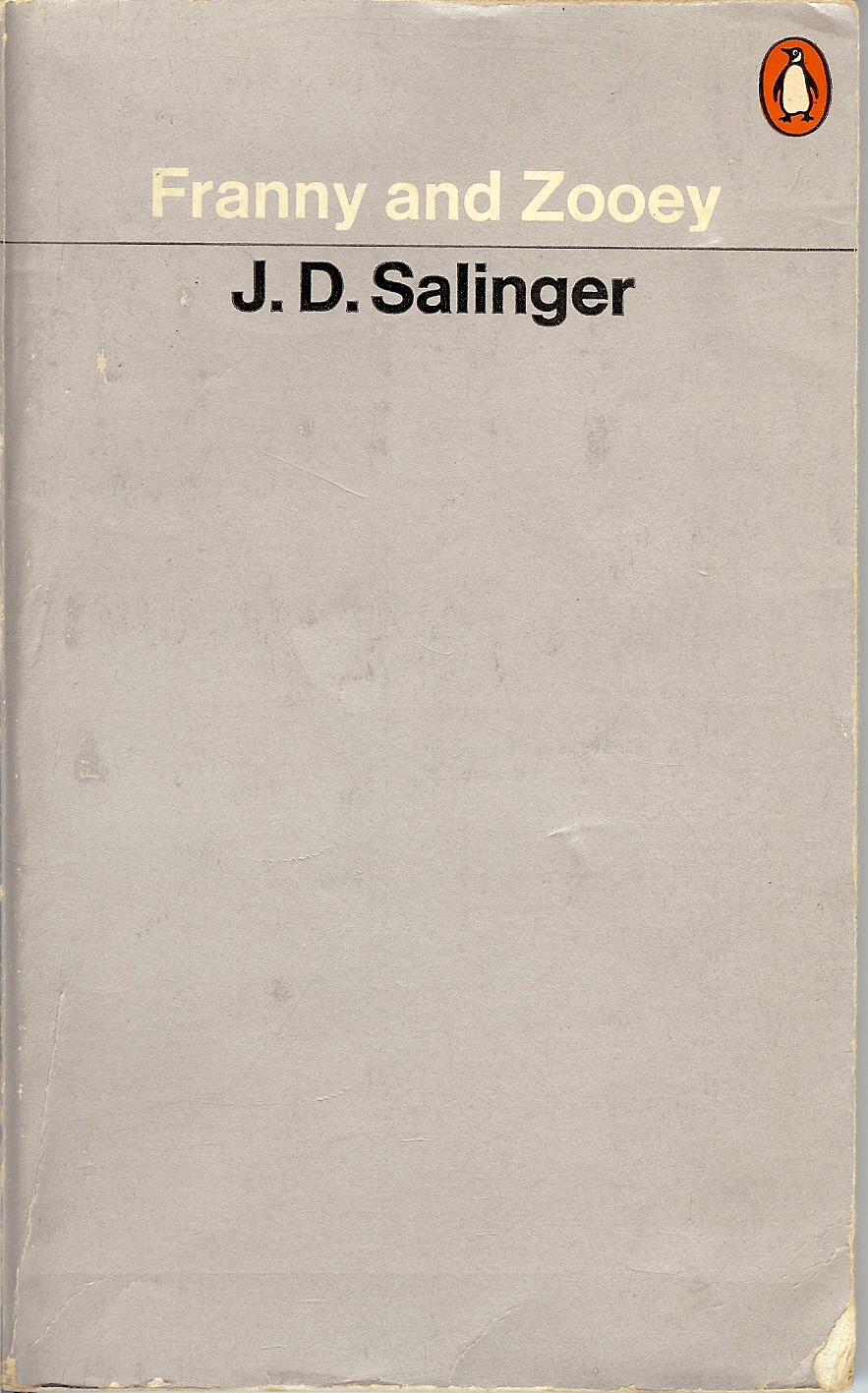

So one day, I put my hurt aside and began to read.
And word by word, page by page and story by story, Cassie’s favourite books became my favourite books and I forgave myself for loving her.
Cheers
Michael
ps: For those who like a happier ending. A couple of weeks into the next term a girl from a different tutorial who Ididn’t know that well came up to me and beat me over the head with a club and dragged me into a cave. Or more literally, she asked me if I’d like to go with her to an upcoming University College Ball. I’m pretty sure I was saying Yes before I even knew what she was inviting me to. From that moment on, my year improved significantly.
pps: And here’s something a little weird. At the end of Dip Ed, I said goodbye to Cassie and we exchanged contact details that neither of us would ever use. I only ever saw her again once. It was the following year and strangely enough it was at my first ever Bob Dylan concert. She saw me in the crowd before the show. It was great to catch up and share stories of our first year out teaching. When she left, a friend who was there with me said, “Wow, who was that? I’m impressed. Man, she looked like the Sad-eyed Lady of the Lowlands!” I’d never mentioned anything about that nickname to anyone.
ppps: My favourite tale of unrequited or lost love, and possibly one of the saddest, is in the For Esme With Love and Squalor collection. It’s the short story called The Laughing Man.
In my writing career I have been blessed with many lovely reviews of my books for which I am eternally grateful. But like any author I have also received some absolute shockers. Eg:
“Stupid. Pathetic. Plotless. Stupid. Pathetic. Plotless. Stupid. Did I say pathetic? Oh yeah, and plotless. There’s not much to say about this book…It was that bad. I don’t even have enough respect for the book to review it properly, I’m just warning you to never ever ever ever ever ever ever read it.” (Goodreads Reader’s Review of Don’t Call Me Ishmael)
The fact that the majority of my bad reviews come from close family and friends really just adds to the pain.
So as befits my reputation as a humanitarian, I have put together some suggestions that I’m hoping will assist my fellow writers when dealing with the inevitable, less-than-complimentary reader responses.
I give you: TEN SURE-FIRE WAYS TO COPE WITH A BAD REVIEW.
1. Read the review carefully and pick up on any spelling, punctuation or grammar errors however minor, so that you can use them to undermine the credibility of the reviewer.
Eg for the review above: “Aaaa-ha! There should have been a full stop after ‘properly’ not a comma! This person is obviously illiterate – and probably a devil worshipping serial killer! What would they know about literature.”
2. Convince yourself that the review was really written by some famous author who was just insanely jealous of your brilliance and was trying to sabotage your success.
Eg for above: “Hey, I recognise that turn of phrase. You bastard Markus!!!”
3. Use Babelfish fish to translate the review into another language, preferably one with which you are unfamiliar. This will make it sound much more palatable. For instance, a comment like “This book really sucks big time!” in French becomes “Ce livre suce vraiment le de premier rang!” Really? You think my book is the ‘premier rang’? Awesome!
Unfortunately this tactic isn’t always a hundred percent effective, as the following Babelfish translation of part of my review above shows.
“Stupide. Pathétique. Plotless. Stupide. Pathétique. Plotless. Stupide. Est-ce que j’ai dit pathétique ? Oh ouais, et plotless … ” (I think you’ll agree, the gist of the review is probably still evident to the discerning reader.)
4. Just man-(or woman)-up and take it on the chin! Seek comfort in the good reviews you’ve received from readers in the past who have genuinely enjoyed your writing. Welcome the criticism, however harsh, with good grace, and understand that each reader is different and will come to your work with his or her own unique tastes, values and life experiences. Don’t fear criticism or resent it. Learn to accept it, embrace it and move on. And this above all else, be happy and content with the knowledge that you did your very best and that you put your heart and soul into everything you wrote – even if not everyone else appreciates your efforts. (Sorry, just jokin’. Thought I’d slip a really ridiculous one in for a laugh.)
5. Use it as a tool for improvement. Look for any tips, techniques or constructive criticism in the review and try to apply them to your writing. Perhaps make a list (see blog 24 ) of the important things you must remember for next time.
Eg: 1. Avoid being ‘stupid’ and ‘pathetic’ (apparently this is bad) 2. Include a ‘plot’ 3. Google ‘plot’ 4. Try using repetition for emphasis 5. Never ever ever ever ever ever ever read my own book
6. Rebut the criticism leveled at you calmly and pleasantly with wit, intelligence and logic.
Eg: “Oh yeah? Well you smell!” or perhaps“I’m stupid and pathetic? Well, do you know who I think is stupid and pathetic? Me! No, wait on, YOU! That’s who!”
7. Write a Letter to the Editor quoting large slabs of the review as clear proof that the Government needs to spend more money supporting people with mental health issues.
8. Desperately trawl the web for reviews of other people’s books that are even more scathing and negative than yours and take heart from someone else’s misery.
9. Drink to forget.
10. Write a blog.
Cheers Michael